
AI Coding Agent for
Azure DevOps
From a single @mention to a working pull request — without ever leaving Azure DevOps.
Everything Azent can do
A coding teammate that lives where your work already lives. Open a comment, ask, and it gets done.
Build features
Picks up a work item, implements it, and opens a working pull request with tests.
Fix bugs
Reproduces the issue, locates the cause, and ships a real fix — no fragile patches.
Review pull requests
Catches style, correctness, edge case, and security issues before humans do.
Address PR comments
Turns reviewer feedback into the next revision and pushes it to the same pull request.
Maintain the backlog
Breaks vague epics into well-scoped work items with clear acceptance criteria.
Propose a technical approach
Sketches a solution and discusses trade-offs in the work item before writing a line of code.
…and anything else you can describe
Azent is a general-purpose coding agent — the categories above are just where teams start. If you can write the task in a comment, Azent can take it on.
How It Works
From a single @mention to a working pull request — in the same thread.
- 1
Open any work item
Bug, feature, or issue from your backlog.
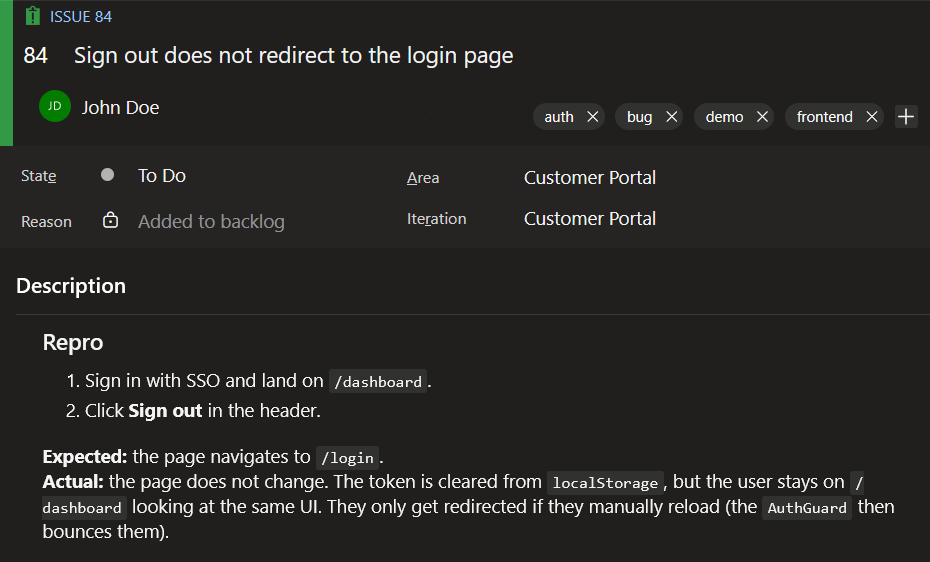
- 2
You @mention Azent
From the work item or any pull-request comment.
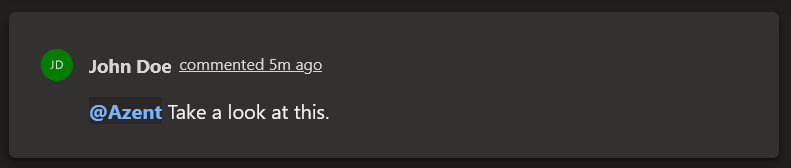
- 3
Azent picks it up
Replies in the same thread — queued, then working.
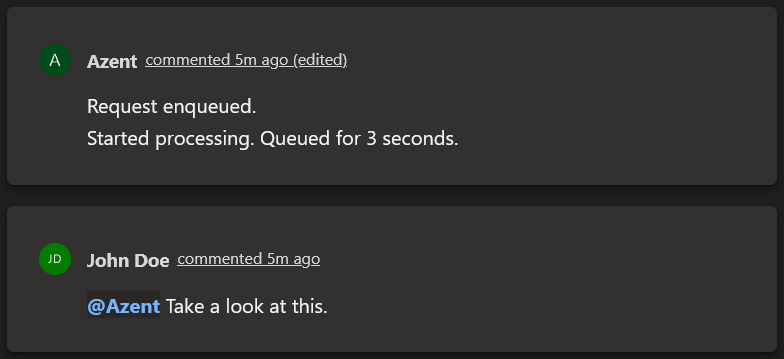
- 4
Summary lands in-thread
What changed, what was tested, and a link to the pull request.
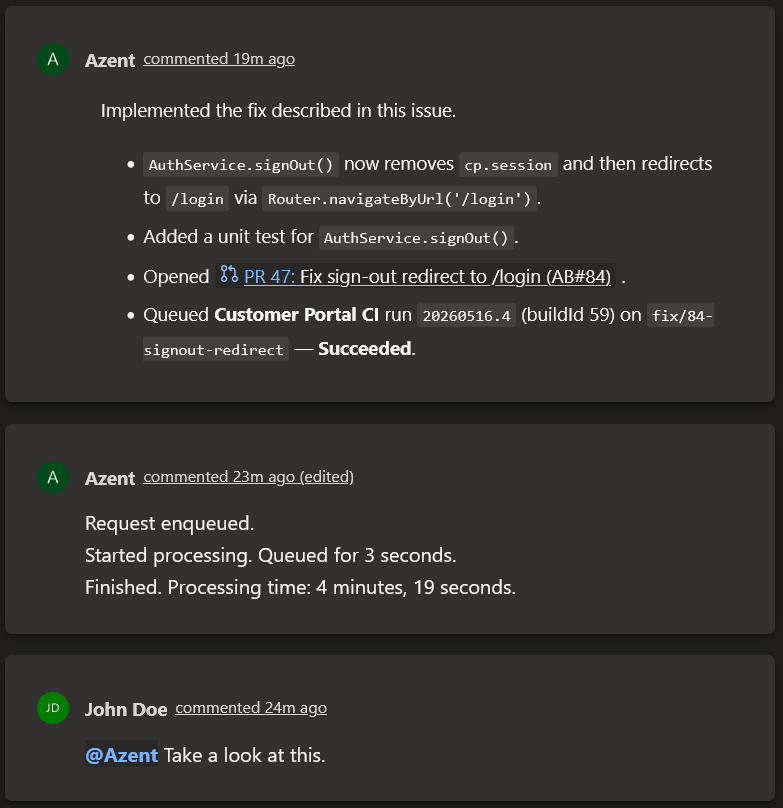
- 5
Pull request ready to review
Linked back to the work item — yours to approve.
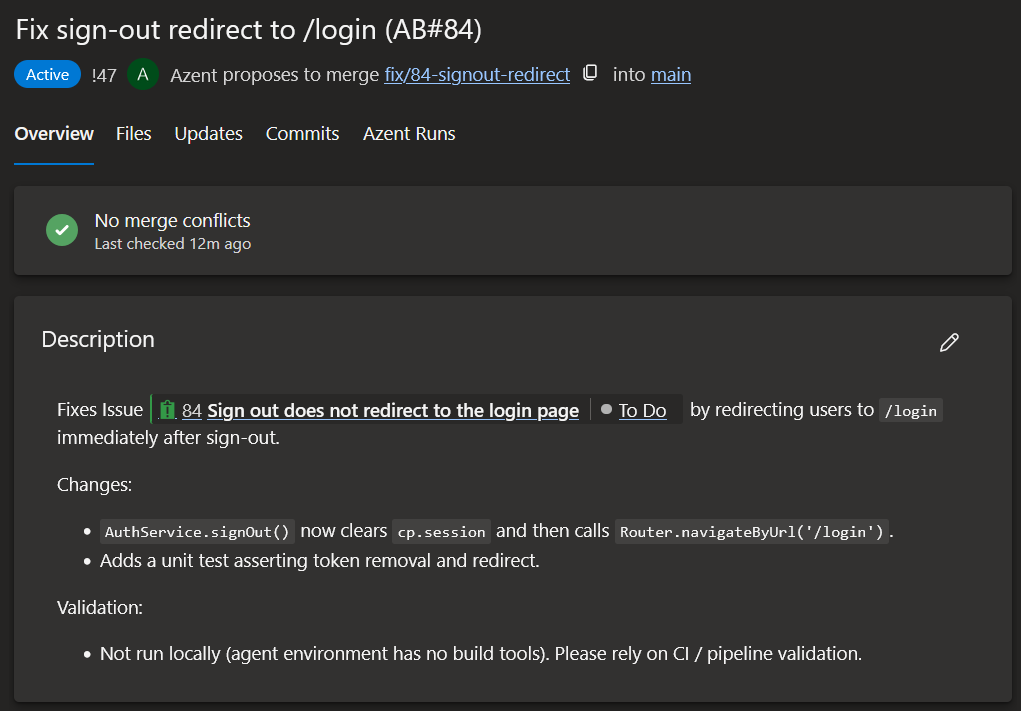


Why teams choose Azent
Native to your DevOps. Bring your own AI. Keep your data where you want it.
Lives where your team already works
No new tab, no new tool, no new workflow. Azent listens for an @mention in any work item or pull request and replies in the same thread — just like a colleague.
- Trigger from work items or pull requests
- Optional Azure DevOps extension for one-click runs
- Status, branches, and PRs land back inside Azure DevOps


Pick the agent. Pick the backend. Pay providers directly.
No model lock-in and no marked-up tokens. Choose Claude Code or Codex, point it at your direct API or your Azure AI Foundry deployment, and Azent uses it.
- Claude Code or Codex — switchable per workspace
- Run on a direct Anthropic / OpenAI API or on Azure AI Foundry
- Choose the exact model and reasoning effort
- You hold the keys — rotate, revoke, or swap any time
Self-hosted with Foundry. Nothing leaves your subscription.
Deploy Azent into your own Azure subscription with Bicep. Pair it with Azure AI Foundry and the entire path — repo content, prompts, model output — stays inside your tenant.
- One-command Bicep deployment to your subscription
- Foundry keeps AI processing under your Azure governance
- Region selection, private networking, your IAM
- Unlimited agent hours under one license
You decide how much rope to give it
Azent operates through an Azure DevOps Personal Access Token. The PAT scopes are its hard ceiling — pick the scopes you're comfortable with and the agent does whatever you ask, as long as it fits inside.
PAT scopes are the ceiling
Code, work items, build, wiki, release — tick only the scopes you want the agent to have. There's no separate access path.
Inside, anything goes
Within the PAT's scopes the agent does whatever you instruct — from a one-off code question to a full feature shipped end to end.
Custom instructions per repo
Drop a CLAUDE.md or AGENTS.md with your conventions and guardrails — Azent reads it before each task.
Revocable any time
Rotate or revoke the PAT — the agent loses access immediately. No deeper credential to clean up.
Two ways to run Azent
Same agent, two operating models. Pick the one that fits your team and compliance posture.
SaaS
We host the platform. Sign up, connect your Azure DevOps organization, plug in your AI key, and you're running in minutes.
- Zero infrastructure to run
- Fastest path from sign-up to first @mention
- Monthly subscription with included agent hours
- Hosted on Azure in Europe — always up to date
- Direct API to Anthropic or OpenAI
Teams that want it to work without managing servers.
Self-Hosted
Install Azent into your own Azure subscription with a single Bicep template. Your tenant, your network, your governance.
- Full data residency in your tenant
- One-command Bicep deployment
- Azure AI Foundry support — no traffic leaves Azure
- Annual license, unlimited agent hours
- Region selection, private VNet, your IAM
Regulated industries and teams with strict data-residency or compliance requirements.
Pricing
Simple, transparent pricing. Start small and scale as you grow.
Starter
For individuals and small teams getting started.
- 10 agent hours/month
- 1 concurrent run
- All use cases
- Dashboard access
Team
For growing teams that need more capacity.
- 50 agent hours/month
- 3 concurrent runs
- All use cases
- Dashboard access
- Priority support
Business
For teams with heavy workloads.
- 200 agent hours/month
- 8 concurrent runs
- All use cases
- Dashboard access
- Priority support
Enterprise
Tailored to your organization's needs.
- Custom agent hours
- Custom concurrent runs
- Volume discounts
- Dedicated support
- SLA guarantee
Frequently Asked Questions
Quick answers to the questions teams ask most.
What can Azent do?
CLAUDE.md or AGENTS.md file. How is Azent different from other AI coding agents?
Where does Azent run?
Is our code used to train Azent?
Which AI models does Azent use?
Does self-hosted mean no data leaves our environment?
What is an agent hour?
Put Azent to work in your Azure DevOps.
Pick a plan and start in minutes — or talk to us about guided rollouts, self-hosted deployment, or volume pricing.
Fixed. The issue was that the required validator checked value.length > 0 without trimming, so whitespace-only strings slipped through and caused the null reference downstream.
Added a sanitizeInput() step before validation that trims all text fields, and wrapped the submission handler in an error boundary as a safety net. Three unit tests added for whitespace edge cases. Opened PR 64: handle whitespace-only input for review.